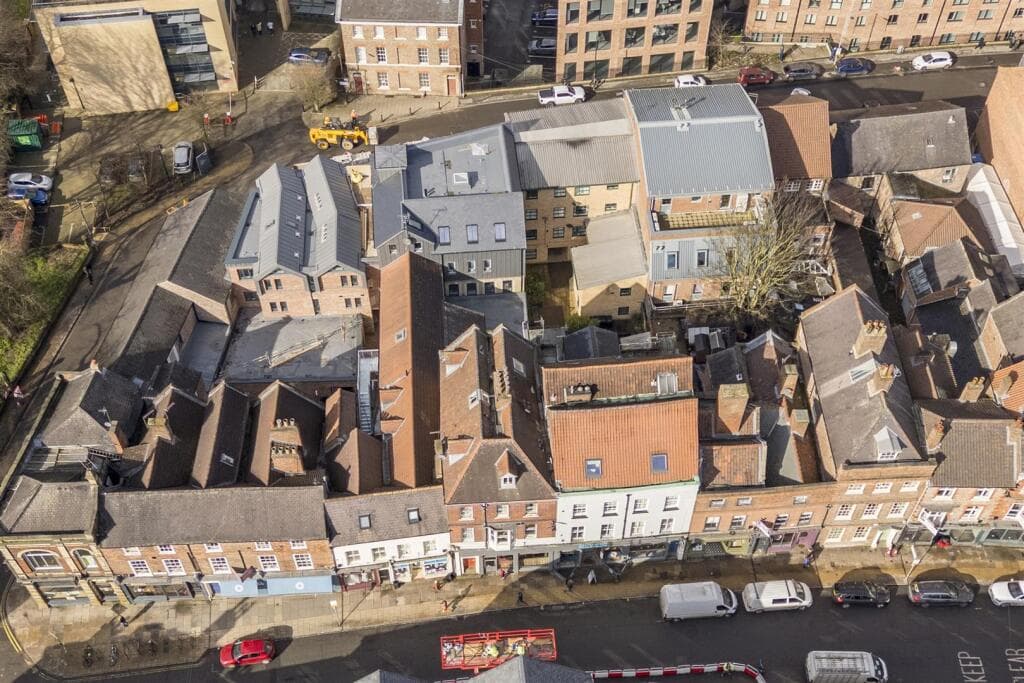
What is a flying freehold?
A flying freehold exists where part of a freehold property extends over or under land owned by somebody else.
Common examples include a room above a shared passageway, an overhanging first floor, a balcony projecting over adjoining land or part of a building sitting above another title.
They are often found in older buildings and historic town and city centres.
Why it matters
The issue is rarely the physical arrangement alone.
The real question is whether the legal documents properly deal with the practical relationship between the two properties.
Before committing to a purchase, I want to understand:
- What part of the property sits above or below another title.
- Whether there are rights of support, shelter and protection.
- Whether there are suitable rights of access for inspection, maintenance and repair.
- How responsibility for repairs and associated costs is dealt with.
- How the building is insured and whether the arrangements are workable.
- Whether the proposed lender is comfortable with the specific arrangement.
Lender and insurance considerations
Lender criteria are not uniform. Some lenders are comfortable with certain flying-freehold arrangements, while others may impose conditions or decline the property altogether.
That is why the finance conversation needs to happen early. A lender’s view can be just as important as the legal wording.
Insurance also needs to be considered carefully. Where structural elements affect more than one property, the insurance position should be clear, practical and capable of working if a claim arises.
The role of the solicitor
A good conveyancer should review the title, relevant deeds and supporting documents in detail.
The objective is not simply to identify that a flying freehold exists. It is to understand whether the rights, obligations and protections are sufficient for the specific property, lender and ownership structure involved.
Indemnity insurance may sometimes be considered where documents are incomplete, but it is not a substitute for proper legal due diligence or a lender’s approval.
My view
Flying freeholds are a good example of why property due diligence cannot be reduced to a headline price or a quick viewing.
They are not necessarily a deal-breaker. But they do require an early, informed and properly documented assessment.
The risk is not complexity itself. The risk is failing to understand complexity before you commit.
Sources
Important
This article is general information only. It is not legal, lending, insurance or investment advice. A flying freehold must be assessed property by property by an appropriately qualified solicitor, insurer and proposed lender.